
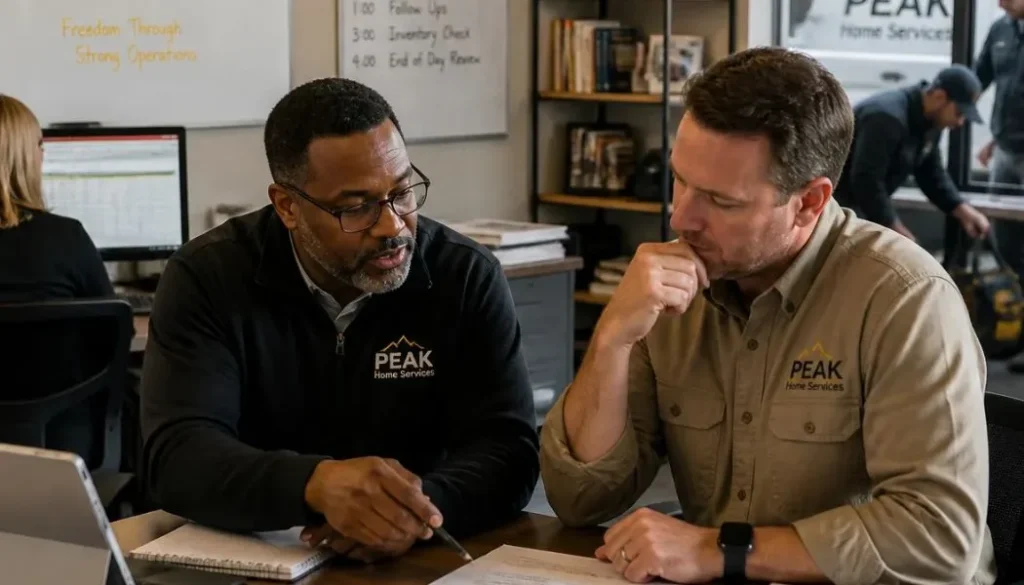
For most home service companies doing $5M to $20M, one of the fractional COO roles is a better fit than a full time COO. You get a senior operator who has built and run companies, for part of the week, at a fraction of the cost. Your GM or ops manager runs the day. The fractional COO leads the business with you. Most engagements run one to three years.
If you’re asking “should I just hire a COO or GM?”, you’re probably tired. The business grew fast. You ignored systems because there was always another job to run. Now leads are coming in, chaos is following, and every problem still ends up on your phone. You’re the answer man, and you’re on call 24/7.
A new hire feels like the fix. Sometimes it is. Often it’s just the most expensive way to find out the business was never built to be handed off.
Fractional COO vs. Full Time COO: Side by Side
| Compare | Fractional COO | Full Time COO or GM |
|---|---|---|
| Monthly cost | $8,000 to $20,000 | Full salary plus benefits, bonus, and often equity |
| Time to start | A few weeks | Often months of searching and interviews |
| Time in your business | A few days a month to about two days a week | Every day |
| Best at | Building and leading the systems, the scorecard, and the leadership team | Being on site every day to run execution |
| Experience level | Senior operator who has seen your problem before | Varies with what you can afford to pay |
| If it doesn’t work | Scale down or end it | Severance, a new search, lost months |
| Best stage | $5M to $20M, for one to three years or longer | $20M and up, when the job needs a full time executive on site |
The short version: most companies under $20M need senior operating leadership, not a full time executive salary. A fractional COO gives you the first without the second.
The Real Question Isn’t Which Title to Hire
Owners usually frame this as a hiring problem. It’s usually a growth problem. Sales sells work operations can’t deliver. Marketing buys leads the CSRs don’t book. Pricing hasn’t changed since labor costs and other COGS have jumped. Each department does its job, and the business still stalls.
A new COO walking into that will spend a year learning why. Some don’t last long enough to fix it.
That’s why the right fractional COO also works as a fractional chief growth officer. The job isn’t just home service operations. It’s lining up sales, operations, pricing, and marketing so growth turns into profit. That’s revenue operations, and it’s the work that lets the business run without you.
Which Role Fits Your Growth Ceiling
Stuck around $2M
You don’t need a COO yet. You need a tighter sales process and a few basic systems. Spend the money on a strong office manager or a lead tech who can run the field.
Stuck around $5M
This is where things start to crack. You’re good at the work but stretched thin running the business. Processes that worked at $2M are breaking. A fractional COO fits here. The company can’t yet carry a full executive salary, but it badly needs executive thinking.
Stuck around $10M
You have managers, but you’re still managing everything. Revenue grew and profit didn’t. A fractional COO builds the leadership team, the scorecard, and the operating rhythm, then leads that team week after week. Your GM runs the day. The fractional COO keeps the whole business pointed at profit.
Pushing toward $20M
At this size, some companies need an executive on site every day, and a full time COO may make sense. Many don’t. If your GM runs the day well, a fractional COO can keep leading strategy, systems, and the leadership team without adding a full executive salary.
What a Fractional COO Builds That a New Hire Usually Can’t
A full time COO is usually hired to run what exists. A fractional COO builds what’s missing and keeps leading it. Here’s what that covers.
Owner Leverage and Exit From the Day to Day
“How do I stop being the bottleneck?” A new hire can’t take decisions off your plate if nobody has defined which ones they own. A fractional COO maps your decisions, hands the right ones to managers, and backs them with numbers you can trust.
Operational Systems (Like EOS) and SOPs
I run EOS in every company I work with: a weekly scorecard, a weekly leadership meeting, and quarterly priorities. Add SOPs for dispatch, estimating, and job closeout, and your managers have something to run instead of something to invent.
Revenue Growth Strategy
Growth that adds revenue but shrinks margin isn’t growth. We look at job costing and pricing first. One plumbing company added $500K to its bottom line from services it already offered.
Sales Process and CRM Alignment
Missed calls, slow estimate follow up, and one option quotes cost more than any salary. We set CSR booking targets, add good, better, best options, and clean up the CRM so reports match reality.
Local SEO and Lead Generation
Leads should match what your crews can handle. I led customer acquisition for an asphalt company that grew from $2M to $5M in twelve months, with operations built to keep pace.
Google Ads and Paid Media Management
Google Ads costs keep rising. A new hire from outside the trades may not know what to question in an agency report. A fractional COO holds every channel, including LSAs, to cost per booked job and margin.
Fractional or Full Time? How It Plays Out by Trade
HVAC Companies
Summer heat in Phoenix or Houston can triple call volume, then spring goes quiet. A full time COO hired in July spends the season fighting fires. A fractional COO builds capacity planning and a membership program, then tunes both every season as the business grows.
Plumbing Businesses
Emergency work makes dispatch the whole game. If your best dispatcher is the only one who knows how the board works, fix that before you add another manager to the org chart.
Roofing Contractors
Storm seasons on the Gulf Coast and hail in Texas create boom and bust years. A fractional COO can flex up during a storm surge and back down after, which a salary can’t.
Electrical Companies
Service and construction run on different numbers. A fractional COO sets up job costing for both and reviews it with your managers every week.
Painting Companies
Most painting companies hit the ceiling on estimating and crew productivity. Those are fixable systems, and a fractional engagement is usually enough to fix them.
Home Restoration and Remediation
Aging housing stock keeps demand steady, but insurance A/R can sit for months. A fractional COO builds the collections and 24/7 response systems, then holds the team to them every week.
Logistics Companies
I’ve sat in the full time seat. I was general manager with CEO responsibilities of a trucking and freight brokerage near bankruptcy, got it profitable in under 24 months, and helped grow it to $50M. That’s the experience you get in a fractional engagement, without the full time salary.
What a One to Three Year Engagement Looks Like
A fractional COO isn’t a project you finish. It’s a seat on your leadership team. Most engagements run one to three years because the results keep compounding.
- Months 1 to 3: diagnose and stabilize. Find the real constraint, stand up the scorecard and weekly meeting, and stop the biggest leaks.
- Months 4 to 12: build the operating system. SOPs, pricing, dispatch rules, and a leadership team that owns its numbers.
- Year 2: grow on purpose. Add capacity, service lines, or locations with a playbook instead of a gamble.
- Year 3 and beyond: build value. Margins, leadership depth, and owner independence that make the company worth more, whether you keep it or sell it.
You get executive leadership the whole way, without the salary, the long search, or the risk of a bad hire.
Who a Fractional COO Is Right For
A good fit
- You’re doing $5M to $20M and growth has outrun your systems.
- You run an HVAC, plumbing, roofing, electrical, painting, restoration, or logistics company.
- You’ve thought about hiring a COO, but the salary and the risk of a bad hire hold you back.
- You’re ready to let someone else run the meeting and hold the team to the numbers.
Not a fit
- You’re under $5M. You might be better hiring a fractional COO for one project first.
- Your systems already run well and you just need a daily operator. Hire full time.
- You want leads, not change.
Common Questions About Fractional COO Roles
Should I hire a COO or a GM?
At most home service companies under $20M, a GM who runs daily operations is the more common first hire. Many owners pair a GM who runs the day with a fractional COO who leads the business.
How long does a fractional COO engagement last?
Most run one to three years, and some go longer. As long as the scorecard keeps moving, the seat keeps earning its place.
Do I need a COO or just better leads?
If you can’t handle the leads you have, more leads make it worse. Fix conversion, capacity, and pricing first.
Book a Growth Diagnostic Call
This is a 30 minute working session, not a free consultation. Bring your numbers and your hiring question. We’ll look at where the business is stuck and whether you need a fractional COO, a full time hire, or neither yet. You’ll get a straight answer either way.